A Working Library on AI, Governance, and Human Judgment
Essays, briefs, maps, prototypes, and practical tools for making generative AI more intelligible and accountable in real organizations.
I use this site to sharpen and connect my thinking across generative AI, governance, cybersecurity, philosophy, and human judgment. Some pieces are technical, some are philosophical, and some are simply working models for problems I keep encountering. The site is public because others may find the material useful too.
Who This Site Is For
This site is for executives, technologists, governance professionals, consultants, educators, and serious readers trying to make sense of generative AI in real organizations.
The work here combines practitioner experience, philosophical interpretation, and governance discipline. The recurring question is practical: how can we use powerful AI tools without confusing fluency for understanding, automation for judgment, or interface behavior for institutional trust?
The AI & Governance Stack
A skeleton key to this site’s corpus: a seven-layer diagnostic map for locating where AI problems tend to live: in meaning, system behavior, interface design, organizational reality, work practice, governance handoff, or human judgment.
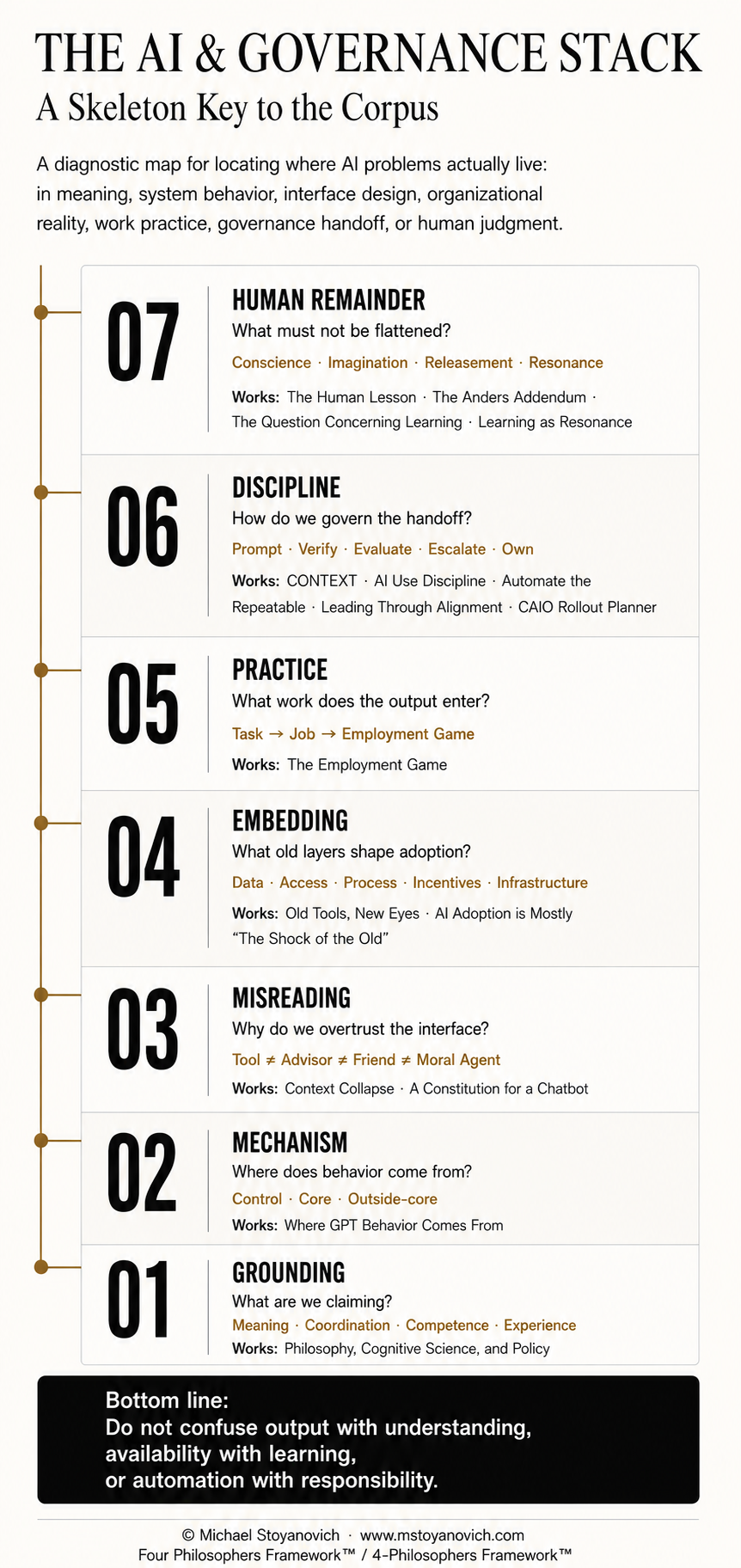
You can also use the AI & Governance Stack as a reading path. Start with Grounding and Mechanism for the conceptual foundation, move through Misreading, Embedding, and Practice for organizational adoption questions, and use Discipline and Human Remainder for governance tools and judgment-centered concerns.
📄 Download Stack Map (PDF) (v3, May 2026)
Start Here
There is no required path through the material. Start with the core framework if you want the conceptual foundation, use the briefs if you want shorter applied models, or go directly to the tools if you want something practical to try.
- New to this perspective? Start with the Four Philosophers Framework™ to explore how Wittgenstein, Lewis, Dennett, and Nagel help us understand AI.
- Want a practical prompting tool? Download the CONTEXT Prompt Framework Guide for a structured way to get better results from AI.
- Reviewing AI-assisted work? Use The Accountable Mediation Checklist to test whether claims are traceable, proportionate, verified where needed, and owned by a human author or accountable role.
- Prefer interaction? Try the chatbots: Four Philosophers Chatbot or CONTEXT Chatbot.
Ephemera: Essays and Papers
Longer essays and working papers on generative AI, philosophy, governance, cybersecurity, and human judgment. Use this section when you want the deeper conceptual foundation behind the shorter briefs, tools, and maps elsewhere on the site.
Suggested path: Philosophy, Cognitive Science, and Policy → Where GPT Behavior Comes From → Old Tools, New Eyes → The Human Lesson → The Question Concerning Learning → Learning as Resonance.
Optional branch: Context Collapse and the Four Philosophers.
-
Philosophy, Cognitive Science, and Policy Start here
Use this when: you want a deeper conceptual map for why GPTs can be useful without being human-like minds.
A Four-Philosophers Framework for Understanding Generative AI
This conceptual lens draws on Wittgenstein, Lewis, Dennett, and Nagel to examine language, reasoning, intention, and consciousness in AI: a compact lens for meaning, norms, competence, and experience.
📄 Download Paper (PDF) (v1.25.2, updated )
“So What? The 10 Things to Implement” — a one-page practical checklist. -
Where GPT Behavior Comes From Map
Use this when: you want a plain-language way to explain how GPT behavior emerges from training data, model architecture, prompting, and interaction context.
Four Philosophers, a linguistic stack, and a practical map of deployed systems
When a GPT “hallucinates,” where in the stack did things go wrong? This essay links a four-philosophers lens (Wittgenstein, Lewis, Dennett, and Nagel) to a linguistics stack, and then maps both onto a plain-text GPT system. The map separates the system into three interdependent lanes: Control, Core, and Outside-core.
📄 Download Paper (PDF) (v1.3.3, updated )
-
Old Tools, New Eyes Persistence
Use this when: AI adoption feels new, but the organizational patterns look familiar.
Edgerton’s The Shock of the Old through Wittgenstein, Lewis, Dennett, and Nagel
Most technology talk fixates on invention; most of our lives are governed by what persists. This essay reads David Edgerton’s The Shock of the Old through the Four Philosophers Framework™ to explain why meaning, convention, cognitive bias, and layered experience keep old infrastructures in charge even in the age of AI. It offers a lens for seeing AI deployments as layers on top of legacy systems rather than clean breaks from the past.
📄 Download Paper (PDF) (v1.4.3, published )
-
The Human Lesson Counterweight
Use this when: you want to think through what AI competence does, and does not, tell us about human judgment, experience, and responsibility.
A response to Sutton’s “Bitter Lesson” through Wittgenstein, Lewis, Dennett, and Nagel
Why competence without comprehension strains explainability, responsibility, and civil trust.
For workflow decisions about automation and human responsibility, see Automate the Repeatable, Own the Judgment.
📄 Download Paper (PDF) (v1.6.3, updated )
-
Context Collapse and the Four Philosophers Guardrails
Ontological collapse, LLMs, and the Four Philosophers Framework
Examines how treating chatbots “as if” they were interlocutors collapses the distinction between tools and persons, using Wittgenstein, Lewis, Dennett, and Nagel to diagnose this ontological collapse and to propose design and governance guardrails.
📄 Download Paper (PDF) (v1.4.3, updated )
-
The Question Concerning Learning Deep dive
Babich, Heidegger, and the enframing of intelligence
Prior question: what is learning? Babich and Heidegger on enframing and its implications for modern AI.
📄 Download Paper (PDF) (v1.0.2, updated )
-
Learning as Resonance Encounter
A note on Rosa, Heidegger, and AI
Companion note to The Question Concerning Learning: why AI-supported learning should preserve encounter, resistance, answerability, and transformation, not just speed, access, or output quality.
📄 Download Paper (PDF) (v1.0.2, published )
Briefs & Whitepapers
Shorter, more focused pieces: conceptual models, one-pagers, whitepapers, and applied frameworks. Use this section when you want a practical entry point into a specific problem, pattern, or governance question.
-
Context is the Way Back
Accountable Mediation, Agentic AI, and the New Handoff Problem
A practitioner brief on why agentic AI governance must extend beyond final-output review to the handoffs among agents, tools, memory, evidence, and human decision-makers. It offers a practical test and 10-question diagnostic for preserving context, uncertainty, traceability, permission discipline, and accountable human ownership across agentic workflows.
For a checklist to use when reviewing AI-assisted work, see The Accountable Mediation Checklist.
📄 Download Brief (PDF) (v1.1.3, published )
-
The Employment Game
Work as a socially embedded practice in the age of AI
A conceptual brief arguing that jobs are not merely bundles of tasks, but socially embedded practices carried out within a wider “employment game” of permissions, exceptions, coordination, accountability, and practical know-how. Introduces a five-layer model and applies it to benefits administration and cybersecurity/GRC.
📄 Download Brief (PDF) (v1.8.2, published )
-
A Constitution for a Chatbot
Vendor constitutions, interface ontology, and local controls
An analytic governance brief arguing that vendor “constitutions” can reduce behavioral risk while amplifying ontological risk unless translated into local, auditable, role-bound practice. Includes a reusable local AI constitution template, an illustrative regulated instantiation, and a diagram of the full “constitution stack.”
📄 Download Brief (PDF) (v1.1.4, published )
-
The Anders Addendum
When action-power exceeds imagination
A governance-oriented addendum introducing Günther Anders’s “Promethean gap” as an escalation trigger: when system scale, speed, or blast radius outstrips responsible human imagination, ownership, and answerability.
📄 Download Brief (PDF) (v1.0.2, published )
-
AI Adoption is Mostly “The Shock of the Old”
A quick crosswalk between my “Old Tools, New Eyes” paper and Every’s field report on what is actually working in companies
A short diagnostic memo mapping real-world AI adoption patterns to four philosophical lenses and to the “old layers” that usually determine success: data, identity/access, process legibility, and incentives/routines.
📄 Download Brief (PDF) (v1.0.2, published )
-
Leading Through Alignment
A framework for the Chief AI Officer
Designed for executives, board members, and technology strategists working to define and institutionalize the CAIO role.
📄 Download Brief (PDF) (v1.2.2, published )
Tools
Practical aids for prompting, reviewing, teaching, and governing AI use.
Use this section when you want something directly usable: a checklist, prompt framework, worksheet, guide, or chatbot.
CONTEXT Prompt Framework Guide
A structured prompting model rooted in philosophy and practice
Use this when: you want a more disciplined way to ask for, shape, and evaluate AI-generated outputs.
The CONTEXT Prompt Framework is a practical structure for making prompts clearer, more bounded, and easier to review.
Grounded in design, education, governance, and communication practice, it helps users define purpose, context, constraints, examples, and success criteria before asking an AI system to produce or revise work.
It is intended as a practical prompting and review aid, not as a guarantee of output quality or suitability.
Use CONTEXT when you are building chatbots, teaching AI literacy, reviewing AI-assisted work, or managing compliance-sensitive AI use.
📄 Download CONTEXT Guide (PDF)
The Accountable Mediation Checklist
A practical review habit for keeping AI-assisted work tethered to sources, evidence, and professional judgment
Use this when: you are drafting, reviewing, or publishing AI-assisted work and want to check whether claims are traceable, proportionate, verified where needed, and owned by a human author or accountable role.
Adapted from the Reality-Contact Resilience Explorer note “Reality-Contact Is Accountable Mediation,” this checklist introduces contact-type tagging as a lightweight way to distinguish direct reading, partial review, summaries, AI-mediated synthesis, data-derived claims, experience, memory, reputation, and unverified claims.
📄 Download Checklist (PDF) (v1.0.1, published )
Automate the Repeatable, Own the Judgment
A three-layer model for using AI without outsourcing responsibility
Use this when: you want to separate what can be automated from what still requires accountable human judgment.
A compact tool for designing AI-enabled workflows: what to automate, what must remain human judgment, and how to govern the handoff so drafts do not silently become “truth.” Includes a practical diagnostic checklist and governance posture.
📄 Download Tool (PDF) (v1.1.1, updated )
AI Use Discipline Kit
A practical “how to use AI” discipline aligned to the DOL AI Literacy Framework
Use this when: you want practical guardrails for deciding when AI assistance is useful, when it needs review, and when it should not be used.
A compact toolkit for using GenAI without outsourcing judgment. Includes a one-page discipline card, a copy/paste prompt scaffold, and a quick evaluation rubric for checking outputs before they become “truth.”
- Discipline card: a repeatable “stance → prompt → boundary → stakes” cycle.
- Prompt scaffold: a structured template for constraints, inputs, and success criteria.
- Evaluation rubric: a quick scoring check for accuracy, logic, fit, and risk.
📄 Download Toolkit (PDF) (v1.0.2, updated )
Custom Instructions for GPT Assistants
Four-Philosophers overlay and governance modes
Use this when: you want a reusable instruction pattern for GPT assistants that need stronger boundaries, validation habits, and governance posture.
A platform-agnostic instruction framework for conversational AI, adaptable to Microsoft Copilot, ChatGPT custom GPTs, and similar systems. The framework combines explicit knowledge-base validation, falsifiability checks, interpretive guardrails, and reasoning quality controls to support transparency, trust, and decision support in complex or higher-stakes use cases.
Chatbots: Four Philosophers Chatbot · CONTEXT Chatbot
Lab Notes & Prototypes
Small exploratory projects that test ideas in public without treating them as finished systems, formal papers, or products.
-
Reality-Contact Resilience Explorer Working prototype
A speculative civic-resilience prototype for thinking about how societies preserve or lose contact with shared reality under conditions of AI, platform mediation, synthetic media, and institutional stress.
This is a heuristic thinking tool, not a prediction engine, validated index, or moral ranking of countries.
Recent Site Notes
A brief log of recent additions, revisions, and housekeeping changes.
- — Updated the published corpus to normalized current releases and canonical filenames, and reconciled publication metadata and references across the site.
- — Updated Philosophy, Cognitive Science, and Policy and its companion checklist, So What? The 10 Things to Implement, to v1.25.1. The revision refines the treatment of retrieval and revision, strengthens the concluding synthesis, and incorporates the distinction among originality, novelty, and authenticity.
- — Updated Context is the Way Back to v1.1.2.
- — Added The Accountable Mediation Checklist, a practical review tool for keeping AI-assisted work tethered to sources, evidence, and professional judgment.
- — Updated Philosophy, Cognitive Science, and Policy to v1.24.2; the companion checklist remained at v1.24.1.
- — Updated Where GPT Behavior Comes From to V1.3.2, adding a narrow clarification that “Core” is used as a governance abstraction rather than as a simplified claim about modern model internals.
- — Updated AI Use Discipline Kit to v1.0.1.
- — Updated Automate the Repeatable, Own the Judgment to v1.1.0.
- — Linked the Reality-Contact Resilience Explorer as a small public working prototype.
- — Updated Philosophy, Cognitive Science, and Policy to v1.24.1 and aligned the companion checklist reference.
- — Added Learning as Resonance, a companion note to The Question Concerning Learning.
- — Added the AI & Governance Stack visual map as a reader-facing guide to the site’s main themes.
About
I’m a technology executive and consultant with decades of experience in information technology, including previous roles as COO, CIO, and CTO. My professional work has included technology strategy, cybersecurity, privacy, governance and risk management, and the development and operation of enterprise systems.
Much of my work has involved helping organizations make practical decisions about technology: what to adopt, how to manage the risks, and how to maintain appropriate human oversight and accountability.
This website is a personal working library. I use it to explore questions arising from that experience, particularly where generative AI intersects with philosophy, cognitive science, organizational practice, and human judgment.
The papers, frameworks, and tools reflect my own interpretations and ongoing inquiry. They are offered as resources that others may find useful, not as definitive answers.
For more about my professional background, see my LinkedIn profile.
Have a use case or experience with AI that connects to this material? Feel free to reach out and share it.